Short answer: Council Bluffs, Iowa is home to a large Google data center, so sessions located there are usually automated: crawlers and other services running on that infrastructure, not shoppers in Iowa. Shopify labels each session as human or bot, and since its September 2026 update, identified bot sessions are left out of session reports by default; use the Human or bot session filter to check.
Real shoppers show up as add to carts and orders, not sessions. CartSpy, a lightweight app for Shopify, lets you watch those come in live, with where each shopper came from.


Shopify estimates a visitor's location from their IP address. Google runs a large data center campus in Council Bluffs, so any request that comes from machines there is placed in Council Bluffs, whatever it is. That includes search engine crawlers, link preview services, price and stock trackers, monitoring tools and other automated checks that run in the cloud.
Merchants in the Shopify Community often connect it with automated store checks, and describe the same pattern: many sessions, one or two pages each, no adds to cart and no orders.
Our own numbers point the same way. From October 6 to November 5, 2026, CartSpy recorded about 310,000 visitors across the 176 stores that use it, and only 45 of them were located in Council Bluffs. CartSpy records shopping steps such as product views and adds to cart, so the many Council Bluffs sessions that show up in Shopify reports rarely appear as shoppers.
Shopify's own Help Center lists the same kinds of visitors as normal bot traffic for an online store: search engines indexing products, social media platforms generating previews, price comparison sites gathering data and monitoring services checking that the site works.
Three things to know. Since the session update rolled out on September 21 to 23, 2026, identified bot sessions are filtered out of session reports by default, so recent reports may already show fewer Council Bluffs sessions. Bot labels exist only for data from October 7, 2025 onward, so older reports cannot be cleaned this way. And Shopify keeps its classification cautious, so some automated sessions can still be counted as human.
Usually not. Shopify points out that blocking bots outright can stop search engines from indexing your products and break social media previews of your links. The traffic does not stop real shoppers from buying. What it does is inflate your session count and pull your conversion rate down, so the fix is in how you read your numbers: filter bot sessions out of the reports you use for decisions.
If your add to carts or checkout starts jump while orders stay flat, that is a different kind of bot, one that touches the cart. See are bots inflating my add-to-cart numbers?
Sessions are the number bots inflate. Add to carts and orders are much harder to fake, so they are the better thing to watch. CartSpy is a lightweight app for Shopify that you glance at to see add to carts and orders come in live, each with the product, the shopper's city and the source or campaign that brought them.
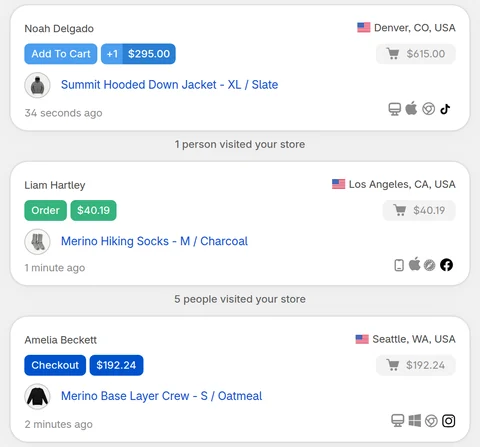
If automated visits do reach your cart, Hide suspected bots leaves out visitors who appear in two countries seconds apart and checkouts opened straight from a link without a store visit. Nothing is deleted, and orders are never hidden.
With the automated visits out of the way, the next question is why real visitors do not buy. See getting traffic but no sales on Shopify.
The listing: CartSpy on the Shopify App Store (apps.shopify.com/cartspy).
Council Bluffs is home to a large Google data center. Sessions located there usually come from automated services running on that infrastructure, such as crawlers and page checks, not from shoppers in Iowa. Merchants often see them as many sessions with no carts and no orders.
Usually not. A real shopper can be located there, but a steady stream of Council Bluffs sessions that view one or two pages, never add to cart and never buy is typical of automated visits.
Filtering is safer than blocking. Shopify notes that blocking bots can stop search engines from indexing your products and break link previews on social media. Filter the sessions out of your reports instead.
In reports that support it, use the Human or bot session dimension and filter. Since Shopify's session update rolled out on September 21 to 23, 2026, identified bot sessions are filtered out of session reports by default, and you can adjust the filter to include them. Bot labels exist only for data from October 7, 2025 onward.
Shopify changed how it measures sessions between September 21 and 23, 2026, and identified bot sessions are now filtered out of session reports by default. Shopify says to treat it as a measurement change: fewer counted sessions and a higher conversion rate do not mean your traffic or orders changed.
It does not stop real shoppers from buying, but it inflates your session count and lowers your conversion rate, which makes it harder to judge your ads and products. Read your numbers with bot sessions filtered out.
Look at add to carts and orders rather than sessions: automated visits rarely add anything to cart. CartSpy, a lightweight app for Shopify, lets you watch add to carts and orders come in live, with the shopper's city and the source that brought them, and can leave suspected bots out of your cart numbers.
Install, and every add to cart and order shows up live with the shopper's city and source. 7-day free trial, cancel any time.
Start free trial